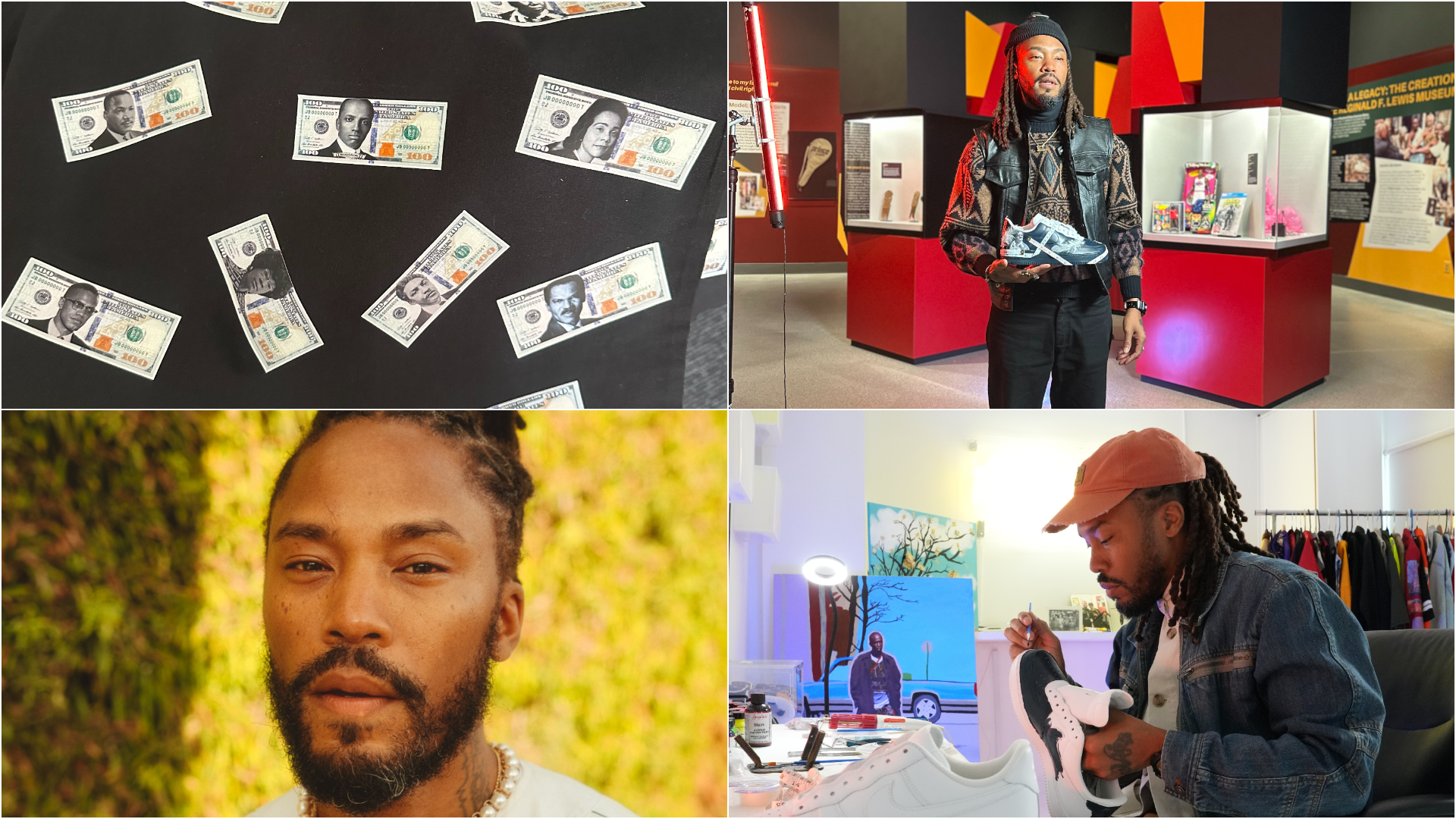
Baltimore native Akio Evans tells stories through fashion, canvas and film, while also teaching and working as a mentor in his native city, Baltimore, and beyond.
His work has been seen worldwide, including his documentary film, Grace After Midnight Pain, the story of the life and times of The Wire actress Felicia ‘Snoop’ Pearson, which he directed and produced alongside Felicia Snoop Pearson and the late Michael K. Williams. His commissioned sneaker art has been collected by the likes of Donnell Rawlings, Dave Chappelle, Dr. Dre, Nick Cannon, Kevin Hart, Havoc of Mobb Deep, Tyronn Lue, Allen Iverson and Lena Waithe.
A recipient of notable honors and awards, including the Joe Mann’s Black Wall Street Award for his contribution to Baltimore’s inner city and personal entrepreneurial achievements and a city citation from former Baltimore Mayor Stephanie Rawlings-Blake for his filmmaking contribution to Baltimore Public Schools.
During CIAA weekend this year in Baltimore, Blavity spoke with Evans about one of his latest pieces, the 100 years of Black History tote bag, which was a special activation at the Reginald F. Lewis Museum. We spoke with Evans about his journey as an artist, career highlights and what’s next, and he makes it known that the messaging will always be key.
Take me through your journey as an artist and as a creator. I read that you started in fashion by learning how to put your art onto clothing. Why was that your initial medium, and how would you say that it has expanded since?
I think that in the beginning, it was my initial medium because I typically wanted to figure out how to eventually not look like anybody else. In the early 2000s, when it was hardly but a thing. I think that over time, it just created the sense of an escape. In high school, the cafeteria was like your fashion show. You would step in and people would observe what you had on. And then it went from me wanting to have it as a side hustle. From that point on, I started to develop a keen eye for things that were new and innovative. I believe that kind of creativity created space for me to fully express myself. Years later, I came to understand that this expression extends beyond custom T-shirts and shoes it carries weight within fine art spaces, thanks to figures like Virgil Abloh and other artists and makers who helped redefine what fashion and art could be.
You took a break from fashion. Though you’ve resurfaced, you share your art and storytelling through so many mediums. You are also a documentary filmmaker and you do a lot of stuff in video production. Talk to us a little bit about your journey from fashion and art to a different version of storytelling behind the lens.
Behind the lens for me, it was more so me being a documentarian at first, picking up the camera and being able to document my peers that surround me, as well as the city. And when I was able to travel abroad, I was able to capture moments that are now archival footage of DMX, Bone Thugs-N-Harmony, Twista and Tech N9ne. And over time, I started wanting to learn how to edit. It just really created another outlet for me to be able to do storytelling.
Working with actresses like Felicia Pearson from The Wire, who hired me to capture her in the essence of her documentary, her memoir, Grace at the Midnight, I turned that into a film. We had two private screenings, one in Harlem and one in Manhattan. But the experience for me has stretched me to be able to know how to execute and be able to have a visual language when it comes to capturing the essence of the individual and telling a story. With storytelling, whether it be clothing or whether it be another medium as far as picking up a camera and being able to document and interview individuals, it’s just another way for me to share a story.
In 2018, I found myself working behind the scenes with GQ, filming photo shoots and contributing to a visual project with Lin-Manuel Miranda for Hamilton. That same period led to an unexpected moment of history—director Derec Dunn later contacted me to use footage I had captured in Baltimore, which became the final live performance of Prodigy of Mobb Deep. I wasn’t even supposed to bring my camera into Baltimore Soundstage, but encouragement from my friend Pat Scott changed that. Looking back, it’s powerful to know that moment was preserved and later used in Boom Goes the Cannon Music Video.
Later, I met Havoc and presented him with a custom Timberland mural art piece commissioned by Atlantic Records a tribute honoring both him and the late Prodigy. I also created a wrap gift for the music video’s director. These moments feel full circle, affirming that my work lives at the intersection of filmmaking, fashion, and storytelling.
Bongo the Cannon, I was able to meet him and also gift him with the Timberland Merrill art that Atlantic Records had commissioned me to be able to give to him, and also the director of that music video. So, it’s full-circle moments when we’re creating these pieces and it shows that filmmaking and fashion can be merged into one.
Is there a medium that you enjoy more than the other?
I think for me I stay rooted in the story and in what I call the ART-i-FACTS. My work isn’t just art it’s an artifact. When I give it to collectors, I’m not just giving a piece I’m giving history. I exist between the art and the facts, serving as the vessel that brings them to life.
Lately, my work has expanded beyond filmmaking into canvas-based pieces. I began working on canvas in 2024, and since then, I’ve been able to sell work and exhibit pieces in ways I hadn’t previously imagined. Before, I primarily worked within the medium of shoes, but encouragement from friends pushed me to explore canvas. That shift has allowed me to expand my imagination into a new space one that the canvas fully supports.
I’ve been putting Harriet Tubman in hunting camo on hats for years, and people didn’t always understand why. It wasn’t until I expanded that idea onto canvas that it began to fully connect. In one of my first pieces, I showed her escaping through a portal into the present day wearing hunting camo. Because when she was in the woods, she wasn’t hunting she was being hunted. She was surviving.
That story mirrors parts of my own life. As a teenager, I was navigating survival in my own way, and now I’m able to bring that understanding to incarcerated youth through my work. At the end of the day, whether it’s film, wearable art, shoe mural art, or canvas, I’m always going to tell the story.
I love creating immersive experiences, whether through wearable art workshops or sharing my work directly. For me, it’s always about the art, the facts, and the stories behind it. Your story and your signature are the most powerful things you have they’re how you leave your mark and create lasting impact.
I’ve always been putting Harriet Tubman on hats of her hunting camo, and people still didn’t get why I was doing that. But through doing that on larger canvases, people have started to finally get why I was doing it. When I was able to do my very first canvas, one of the first canvases I did, I merged Harriet Tubman, where she’s escaping the painting, and she’s going into the middle of a portal. And in modern day time, she will be wearing hunting camo because when she was in the woods, she was being hunted. Most people now hunt for sport, but she had to do those things to survive. And for me, when I was on a run in my early days as a teenager, these are the same stories that I’m able to educate to the incarcerated youth of how I’ve been able to use and put her onto clothing. I think that more so now, whether it be filming, whether it be wearable art, whether it be shoe mural art or canvas work, I just love telling the story.
I love being able to have an immersive experience, whether it’s doing a verbal art workshop of sharing the art, and, of course, actually sharing the facts and the stories, because your story and your signature is the most powerful name that you have. And it’s pretty much what we have to leave behind – the story and the signature is how we leave our mark and make an impact.
Now you’ve had some major influencers and public figures wear your art. Has there been anyone who has been anyone who has been the most memorable or the most impactful?
One moment that stands out happened on my birthday, when I was commissioned by the Visionary Art Museum to create a replica of the jacket John Carlos wore during his iconic protest at the 1968 Olympics. I was able to present that piece to him on my birthday, which made it even more meaningful.
What’s wild is that the very next day, I was scheduled to lead a wearable art workshop in Atlanta. When John Carlos told me, “Next time you’re in Atlanta, I want to show you some of my personal memorabilia,” I had to tell him I’m actually headed there tomorrow. Moments like that remind me how much of this journey is full circle, even when I don’t realize it at the time.
That same energy shows up in my work. Recently, with Lena Waithe, I included a hang tag inside the sneakers I created for her that honored my mother, who passed from a heart attack. It wasn’t just a design choice it was intentional.
For me, the work is never just transactional. It’s about creating something that carries emotion. Taking an inanimate object something that typically holds no feeling and embedding it with story, memory, and meaning. That’s what allows the collector to truly connect with the piece.
You have the 100 years of Black History tote bag, which you gifted some of the journalists, during CIAA weekend. Talk to us a little bit about your inspiration for the bag and how that whole thing came to be.
The tote bag was created in alignment with the vision of the Reginald F. Lewis Museum. It builds on a concept I’ve been exploring for some time placing Black historical figures onto the $100 bill as a way to reframe value and legacy.
This year, it felt especially timely. February marked 100 years since Black History Month, which began as a week founded by Carter G. Woodson. In collaboration with Tracey Johnson of Visit Baltimore, we wanted to highlight him alongside other figures who made a lasting impact on the Civil Rights Movement.
The work also reflects the mission of the museum itself. I included Reginald F. Lewis on the note as well a Baltimore native and the first Black man to build a billion-dollar company. Being from East Baltimore, that connection felt personal, especially because it’s a story many people, including myself at one point, didn’t fully know.
By placing these figures onto currency, the goal is to create a new kind of social currency one that sparks conversation and brings attention to individuals whose contributions are often overlooked. It’s about giving value back to the stories that shaped us.
This also marks my second collaboration with the Reginald F. Lewis Museum. In a previous project, I worked alongside Bird House Media and Kaylin of the museum, to create a visual piece highlighting Anna Murray Douglass.
The piece was created for an event focused on bringing visibility to her legacy centering the often-overlooked story of Anna Murray Douglass and her role in history.
Something that always fascinates me is when I meet people local to their town. You’re Baltimore born and bred, and you have done a lot, but you remain loyal to Baltimore. And a lot of people leave their respective cities that they’re from, specifically artists, for what they may consider to be more mainstream or larger markets. What has kept you local?
I think that what kept me local is the heartbeat here. It is a lot louder, and even when I’m traveling to different cities, it’s a lot louder, whether you’re here or you’re anywhere else. The heartbeat can be your accent that is recognizable. The heartbeat can be the impact that people have seen on television shows, and then when you’re actually going to different other places, when you identify yourself, and you’re actually sharing, I feel like it’s a way where we’re able to really shake things up.
This city, I just love the history. The history is rich, the food, the culture, and it’s a lot more than what people can then recognize from afar. I always share with people, I use the analogy of bees pollinating the hive. They are the teachers, they are the creators, they are the makers, they’re the ones that are beautifying the city, just like how bees do when they go back to a hive. The honey is sweet. Yes, you have your killer bees and the things that can actually harm you, but when you get closer and closer to the hive, it kind of puts it in a different perspective, and if you would have stayed away, you would have never known how great it was.
I feel like the city has so much more to offer. I’m glad to be the vessel to be able to share the complete opposite of what most people worship, or they praise like The Wire or The Corner, and all the negative things that the media has seen. But I love to actually share with people that we’re much more than that. Even if I am just a small seed, I can still inspire.
I spoke with Michael E. Haskins Jr. another local artist from Baltimore, and he spoke about Baltimore in comparison to other cities and how its growing at a rapid pace. How would you say Baltimore is doing in comparison to the larger cities?
Being able to travel to places like LA and Cleveland and all these other places that I’ve been to recently, they always tell me, even people who have been to Baltimore, they say Baltimore is the most raw. We haven’t lost the very essence of what some cities have lost because of gentrification or things change, and things shift. There’s definitely a renaissance happening here, but it’s still the essence of Baltimore, and the community remains involved as it grows.
What special projects are you working on currently?
Currently, I’m prepping for the exhibition that I have with my twin sister at the Quid Nunc Art Gallery. It’s in the Mount Vernon section of Baltimore in the Arts District. I also have a few things in the works that I am unable to speak about right now in collaboration with two different arenas, the Chesapeake Arena and CFG Arena. And I continue to gift things to people.